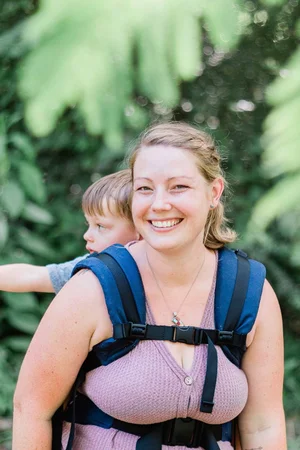

You Don’t Need a Baby to Babywear
Fun fact: you don't actually need a baby to start babywearing!
Okay, eventually you're going to need the baby.
But if the first time you pull your carrier out of the box is when you're sleep deprived, recovering from birth, and holding a newborn who would very much like you to stop messing with straps and buckles and PICK THEM UP NOW…you've chosen a particularly difficult time to learn a new skill.
And that's exactly what babywearing is: a skill.
Not just a piece of baby gear or a convenient way to get your hands back. And definitely not something you have to wait until postpartum to learn.
It's About So Much More Than Having Your Hands Free
Yes, babywearing makes it considerably easier to make yourself lunch while holding a baby who has absolutely no intention of being put down.
But convenience is only the beginning.
Research on infant carrying has found associations or experimental effects involving caregiver responsiveness and attachment, reduced infant crying, and breastfeeding duration.¹ ² ³
And in my own work as a babywearing educator (and through my work with the Center for Babywearing Studies) I've seen carriers used for far more than just getting things done or heading out for a walk.
Babywearing can give babies opportunities for closeness, regulation, movement, varied sensory input and interaction with the world around them. I regularly collaborate with PTs, OTs, chiropractors and families who use thoughtful babywearing as one tool alongside professional care for babies experiencing things like torticollis, low tone, body tension or positional preferences.
It can also help families reduce the amount of time babies spend in containers, vary baby's positioning throughout the day, and provide another option for babies who strongly prefer contact for sleep.
And let’s not forget the parents!
A well-fitted carrier can distribute baby's weight much more comfortably across a recovering postpartum body. It can make leaving the house feel possible again. It can give partners another way to soothe, connect with and care for baby. And I've watched countless new parents go from nervously holding a carrier and saying “I have no idea what I'm doing” to confidently responding to their baby.
Babywearing is a skill that can fundamentally change how you move through early parenthood.
So Why Do We Wait Until Baby Arrives?
You absolutely can learn babywearing postpartum.
But it's a whole lot easier to learn when you aren't also recovering from birth, sleep deprived, hormonal, feeding a newborn, and trying to figure out why the baby is crying.
Prenatally, you have time to:
Try several carrier styles before spending money on one
Figure out what actually feels comfortable on your body
Think about how you'll realistically use babywearing in your life
Learn what safe positioning looks like
Practice putting a carrier on and adjusting it
Build enough muscle memory that you're not starting from zero when baby arrives
And perhaps most importantly:
You have the time (and mental energy) to choose a carrier based on your actual body and lifestyle, not whichever one TikTok has collectively decided is the best this month.
There is no universally “best” baby carrier.
The right carrier is the one that fits your body, your baby, your lifestyle and the way you actually want to use it.
Prepare for Closeness
Most babies want to be held. A lot.
Instead of preparing only for all the places you're going to put your baby, I think it's worth preparing for how you'll comfortably and sustainably hold them, too.
That's exactly why I offer prenatal babywearing education at A Mother's Compass.
We'll meet before you buy a carrier so you can actually try different styles and decide what works for you. Then we'll practice using your chosen carrier while you're still pregnant. Once baby arrives, we'll meet again to adjust the fit for your real baby and consolidate those skills.
Give your postpartum self one less thing to figure out later.
References
Anisfeld E, Casper V, Nozyce M, Cunningham N. Does infant carrying promote attachment? An experimental study of the effects of increased physical contact on the development of attachment. Child Development. 1990.
Hunziker UA, Barr RG. Increased carrying reduces infant crying: A randomized controlled trial. Pediatrics. 1986.
Little EE, Cioffi CC, Bain L, et al. An Infant Carrier Intervention and Breastfeeding Duration: A Randomized Controlled Trial. Pediatrics. 2021.
Norholt H, Phillips R, McNeilly J, Price C. Babywearing Practices and Effects on Parental and Child Physical and Psychological Health. Academic Journal of Pediatrics & Neonatology. 2022;11(1):555876.
Alyousefi-van Dijk K, van ’t Veer AE, Meijer WM, Lotz AM, Rijlaarsdam J, Witteman J, Bakermans-Kranenburg MJ. Babywearing as a Tool to Prevent Dysregulated Autonomic Responses to Infant Crying: Randomized Controlled Trial in Fathers. Psychoneuroendocrinology. 2021;132:105380.
Williams LR, Turner PR, Richmond A, et al. Infant Carrying as a Potential Intervention to Promote Secure Attachments in Adolescent Mothers: The Mediating Role of Maternal Behavior. Infant Behavior and Development. 2025.