

Your Baby Won't Open Wide to Latch? Try This
I hear some version of this from breastfeeding parents all the time:
“I know the latch is supposed to be deeper, but my baby just won't open their mouth wide enough.”
Sometimes feeding hurts. Sometimes baby keeps slipping onto the nipple. Sometimes we're also worried about milk transfer, supply, or weight gain.
There are many things that can contribute to those problems, and a good latch involves much more than how wide baby's mouth opens.
But before we start assuming your baby can't open wider, there's one surprisingly simple thing I always look at:
Is anything touching the back of baby's head?
Baby Needs to Be Able to Tip Their Head Back
Try something for me: put your hand against the back of your own head and gently push your head forward. Now try to open your mouth really, really wide.
Next, take your hand away, tip your head slightly back, and open wide again.
Feel the difference?
Your baby needs that freedom of movement, too.
When babies attach to the breast, we want them to be able to tip their head back, open their mouth widely, and approach the breast chin first. Breastfeeding guidance from both the NHS and UNICEF Baby Friendly Initiative specifically recommends supporting baby's neck, shoulders, and back while keeping the head free to tilt backward.
And yet I frequently see exactly the opposite.
A parent gets baby close to the breast, puts a hand behind baby's head and pushes the head toward the nipple.
I've seen healthcare professionals help parents latch babies this way, too.
It makes intuitive sense…we're trying to help baby get onto the breast, after all!
But that pressure can actually interfere with the head extension baby needs to achieve that lovely wide gape.
Try This Instead
At your next feed:
1. Support baby around the shoulders and upper back, not the back of the head.
Keep baby's body close to yours and their head and body aligned, but leave the head free to move.
2. Start nose-to-nipple.
Position baby so your nipple is around the level of their nose rather than pointing directly into their mouth.
3. Encourage baby to open.
Gently brush your nipple around baby's nose/upper lip and give them a moment. You're looking for that big, yawning mouth, not trying to quickly sneak the nipple in through a little opening. Note: crying does not count as a gape! If your baby is upset, it’s worth calming them first rather than jamming your nipple into their wailing mouth.
4. Let baby's head tip back.
As baby opens, you'll see the chin come forward toward the breast.
5. Bring baby in from the shoulders.
When the mouth is nice and wide, gently bring baby's body toward you so the chin and lower lip arrive first, allowing baby to scoop a larger mouthful of breast rather than simply sucking the nipple into their mouth.
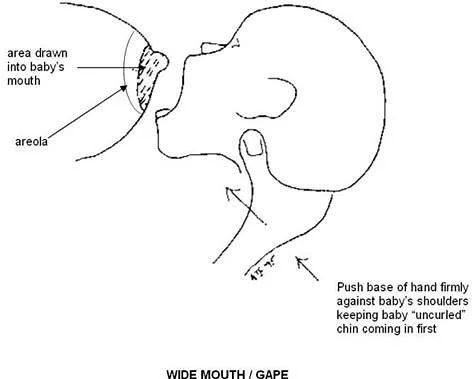
That head-back, chin-first approach is a standard part of positioning and attachment guidance because it helps baby take a larger mouthful of breast.
And Then See What Changes
It's a tiny adjustment, but I've seen it make an enormous difference for some parent-baby pairs.
And importantly, if it doesn't fix the problem, that gives us information too.
Persistent nipple pain, damage, difficulty staying latched, concerns about milk transfer, low supply, or poor weight gain deserve individualized evaluation. Positioning is only one piece of breastfeeding, and sometimes there is something else going on that needs additional support.
But if you keep thinking...
“My baby just won't open wide!”
...take the hand off the back of their head and see what happens when you give them the space to try.
Need Another Set of Eyes on Your Latch?
Sometimes you don't need another diagram - you need someone to actually watch you and your baby feed.
I offer one-on-one lactation education and basic breastfeeding support in my Grinnell office, where we can look at positioning, attachment, feeding cues, and practical adjustments together. And if what I'm seeing is outside my scope as a lactation educator, I'll help connect you with an IBCLC or appropriate healthcare provider for further evaluation.